Bowing to his journal amidst the busyness of the coffee shop, Steven starts in on the final question given to him by a long-distance friend in advance of his psylocibin trip, a question about the nature of his spirituality. “What are your beliefs regarding God?” the question asks. “Do you have reciprocal conversation? Is he/she/it a benevolent force in your life?” Steven nibbles his pen for a moment, then begins writing.

An earlier question had asked after Steven’s relationship to community, and that question had brought on some sadness. For one, the friend who introduced him to psylocibin and who acts as his trip guide lives in another state, part of the same university diaspora that has deposited Steven here. Similarly, Steven has made a few friends since moving for work after college, but none seems to share his interest in this kind of self-exploration, so he didn’t invite them. One of the most promising candidates might have been a female friend Steven met through his gym, but the two have had sex, so the prospect of tripping with her conferred an awkwardness Steven could not stomach. For all these reasons, he will be tripping alone.
Ditto, another question had inquired into Steven’s work, and he reflected that while there is a sense of contributing positively to the world, that sense is abstract, communicated more wholeheartedly on paper than in Steven’s throat. He manages a political canvassing operation, and he often wonders whether the numbers he reports to his overseer justify the experience his individual canvassers may be having on the ground, doors slammed in their faces and harsh words leveled at their bodies. Is there a disjunction here?
Getting into the question about spirituality, Steven considers that at one time he was an atheist, but at this moment the more appropriate label might be agnostic. Prompted by his same long-distance friend, for the first time a few months ago he had done a solo psylocibin journey, and in that experience he had felt buoyed upward to God—or something—in a way that dazzled and left him speechless. Prior to that experience and answering these same journaling questions for the first time, Steven had felt more certain as to the universe’s vacuousness—he had called God an “unlikelihood”—but in this moment he feels persuadable, hypothesizing that something exists and yet not sure how to frame it.
Wrapping up his journaling, Steven also finishes his coffee and returns the mug to the bin from which the staff can retrieve and clean it. More so than the first time, this journaling has felt cursory—he will enter the mushroom experience with both confidence and curiosity, a practiced psychonaut traipsing through familiar terrain.
*
At precisely the same moment but separated by oceans, Kamal solicits banking information from his so-called client.

“One,” she says, “No, I’m sorry, two.” She is providing Kamal with the password to her savings account, a password he enters on the duplicate of her computer screen he has rendered on his own desktop.
“That is alright,” says Kamal, awaiting the next number. The client’s voice is halting, and Kamal assumes this is due to old age but simultaneously ponders whether it indicates the client is beginning to catch on to his scheme; if so, he will truck out the script he and other team members use to allay doubts.
“Wait, why am I giving you my password?” the client asks, confirming Kamal’s suspicion.
“Your computer screen has been frozen by a virus,” Kamal explains, “And because of this, you will be unable to enter the information on your own. I can do so here because I have duplicated your screen, and I need to access your banking information in order to reactivate your anti-virus software.” A single drop of sweat escapes Kamal’s temple and crests his cheek, but it is only due to the unmitigable heat of his Indian office, a heat resilient to the fans that blare all around him. Flipping to the next page in his script in case the client does not respond affirmatively to this rejoinder, Kamal simultaneously wipes the sweat with his sleeve.
*
By this time Steven has left the coffee shop, and is walking the half mile between that coffee shop and the home in which he has prepared the mushroom concoction, planning to strain it into a mug of tea. The walk entails rising up and descending a single, gradual hill, and as he nears the apex the sun slants against Steven’s brow.
In his first mushroom trip a few months ago, Steven had felt utterly terrified as he sipped the tea, directing prayers to a God he didn’t believe in and feeling his pulse gallop ahead of him. Alongside the candle he lit and blanket in which he wrapped himself, he had put on an ethereal album, and of a sudden he had felt himself whisked through and into the landscape of this album, almost as though his body, self, and soul had been transmuted into sound. He had dimmed the lights and donned a sleep mask, and no thought had muddied his mind as he traversed a space he can refer to only as fractal land, a river of pulsing geometric shapes and variegated hues of light. He had felt closer to God in this space than he had previously imagined possible, almost as though the thoughtlessness of his gaze matched God’s objectivity, and the two were so similar as to be synonymous. “Thank you, thank you, thank you,” he had muttered, writhing, pulsing, and thrusting with the music and under the blanket; tears had limned his eyes.
Emerging from the experience, Steven’s greatest and most urgent desire had been to inform his younger brother, who still lives with his parents in the town to which Steven has never looked back. If only his brother could be apprised that such a state existed, Steven believed, then he too would recognize the backwardness and stagnation in which their parents dwell, the necessity of escape that Steven had once intuited. And yet Steven has not spoken with his brother in years, and the exultation of the mushroom trip itself had felt too large to communicate, a further wedge between them as opposed to a helpful bridge.
*
“I’m not so sure about this,” says the elderly woman with whom Kamal is connected, “I’m going to call my husband.”
“I understand,” says Kamal. In moments such as this, he has been trained simultaneously to assuage his client’s fears about the operation, but also to introduce a quandary so that they feel compelled to continue. “Nevertheless,” he continues, “it is important that we schedule payments to your anti-virus software so that it can be reinstated. If we do not do so, your data may be lost.”
“I see,” says the client. From her tone and cadence Kamal can tell not only that she is American, but also that she is from the American south. “Let me think for a moment.”
“Of course,” says Kamal. Again a drop of sweat bubbles from his temple—this time from the other side—and again he wipes it with his sleeve.
Perhaps a month ago, Kamal had accepted a call from a man he interpreted as any other client, a seemingly elderly man who complained of an issue with long loading times; this man’s accent marked him as Scottish. As Kamal had proceeded throughout the call, something had begun to feel strange to him: the man chuckled as Kamal duplicated his desktop and gathered certain information, almost with the air of a father witnessing his child’s first game of t-ball.

Of a sudden, an image of Kamal’s face had revealed itself on his own computer screen, and the Scottish man had declared that he was a YouTuber whose channel consisted of catching and exposing scammers. “You’re very proud of yourself for taking advantage of the elderly, aren’t you?” he had said. In this moment, his tone had changed, the seeming warmth of the chuckle replaced by sarcasm and judgment. Staring down his own face in vivid resolution, Kamal had perceived his computer’s camera as an eye which held his fate in its unblinking appraisal, a sort of God which retained the power either to save him or to doom him.
“You, um, I think you misunderstand me,” Kamal had said. In that moment, the sweat which ran down his face had borne a very different cause from the sweat he now weathers, and he had felt his face hot with the sting of humiliation, his entire body condensed to a bright red dot before the computer’s eye.
“Oh, do I?” the YouTuber had said. “Then how would you explain what you are doing?”
At that point Kamal had kicked free the desktop’s power cord with his right leg, hoping that interrupting the YouTuber’s stream would qualify his footage as unusable. He still hopes that: he hadn’t bothered to tell his boss about the encounter, so he hopes he doesn’t arrive to work one day to discover his poor karma has soiled the team’s operation.
*
Opening the door to his home, Steven takes in the scene he had erected for himself prior to exiting for the coffee shop: the drawn blinds, the prepared blanket, the single candle on his living room table, the speaker with which he will play himself music, and just there, the mushroom infusion with which, momentarily, he will prepare his tea.
As he boils a kettle of water, he muses that his entire life has aligned to produce this moment, this experience. Even if in an ideal world, he wishes he could share the experience with somebody—say his brother—it is by virtue of his aloneness that he can venture so far as he is doing, that he can reach such heights. In other words, his aloneness is what enables him to explore himself with such conviction. And by the same token, even if in his work he would prefer something of greater richness, greater immediacy, it is his work which supports his ability to pay for this apartment, by himself, such that he retains a sort of sanctuary in which to conduct the trip. That is, Steven feels that there is a perspective from which the sore spots in his life constitute its affordances, and he endeavors to amplify this perspective in his mind as he consecrates the tea.
*
After neglecting to call her husband, Kamal’s client has authorized him to finish the procedure, and he has just now automated regular payments from her bank account not to an anti-virus company, but to his own.
“Is there anything else with which I can help you?” Kamal asks, taking out his phone from his pocket.
“No, my dear, you have been wonderful,” says the client. Kamal imagines her as she must appear across the Atlantic and in her southern home. She stands in her bathrobe and facing a living room window, overlooking a freshly trimmed lawn that extends down a hill and terminates in a marsh. Her husband never appreciates the things she does for him, she thinks, always deems himself the one who must “slave away” for their livelihood. At least today she has counteracted that impression by making this important call.
“Well, it has been my pleasure,” says Kamal, and he stanches the connection and thumbs open his phone.
These moments between calls are the closest Kamal experiences to liberation. In these intervals, he knows that even if his boss chances through the office and sees Kamal idle, there will be an allowance for this state; truthfully, he will be able to attest that he just closed a successful call and his boss will smile, pat him on the shoulder, and ignore the phone in Kamal’s hand.

As he navigates to YouTube, Kamal fantasizes how he might have responded to the Scottish vigilante who confronted him that day. For one, he might have explained that colonialism had equipped him, Kamal, with the linguistic and customary skills to act as the vigilante’s servant, but deprived him of the system’s riches; given the internet, these riches are quite literally shoved in Kamal’s face. Does the YouTuber understand what it feels like to live in that contradiction? For another, Kamal might have explained that, following his mother’s death a few years ago, he alone has been tasked with caring for his disabled sister, and this job poses as one of the surest routes to supporting them both. Kamal thinks of the ways in which his coworkers sometimes mock his sister, flapping their hands against their chests like useless dolphin fins and intentionally salivating at the mouth, and how Kamal himself universally keeps mum, protecting his salary. The YouTuber wouldn’t have cared, but Kamal might have explained that he stays up many nights dreaming of finding his own partner and siring his own children, yet unable to square the equations involving himself, his sister, and the cramped apartment they share.
Kamal’s favorite YouTube channel is one in which putative home buyers tour extravagant properties in large American cities. Swiveling his head around again to ensure he is alone, Kamal listens as the host’s voice booms beyond the confines of his slick and dapper suit, watches as aerial views and 360-degree panoramas accentuate the vistas onto which these properties look. And although Kamal envies the buyers, it is not lost on him that they possess attributes life itself has denied him: to a one they are tall and white and speak English without accent, like graduates of the caste system whose virtue is that they’ve forgotten the system exists.
*
Sitting in the lotus position, Steven prays for a blissful experience and downs the mushroom tea. From that moment, he lights his candle, turns on his music, and closes his eyes while anticipating the psilocybin to take hold.
As he begins to feel wavy and curls under his blanket, immediately he gathers that this experience will differ from his first one: where before Steven had felt himself blasted beyond and through himself and into some realm without consciousness, in this iteration he feels as though the bounds of himself are more sharply defined, his limbs’ extension standing out as though painted black and white in a world of color. Furthermore, the fabula of his life emerge and are treated sequentially, as though he has died and is undergoing a life review. He sees his younger brother, the way he had always looked up to Steven as a child… He sees that his brother, like Steven, always had criticisms of his parents, but that Steven alone acted on these criticisms and that his brother has been left without solidarity. He sees that in his work, he is correct to posit a mismatch between actuality and portrayal: the majority of his clients and his canvassers alike probably leave their interactions disgruntled, and even if the door-knocking inspires votes, they are votes of cynicism and disgust.
As the experience continues, the bounds of Steven’s life and of himself seem to shrink further and further inward, like a specimen pressed beneath a microscope to the point of splatter. A voice accompanies him on the trip, but he can’t discern whether it is God’s or his own; the voice tells him that he is stupid, weak, wretched, that his life is a cosmic joke and everybody is laughing but himself. Brought to tears, Steven finds himself mumbling apologies to this distant, critical presence, a sort of incantation that reeks of original sin. “I know, I know, I know,” he repeats, but exactly what he knows he would be unable to say.
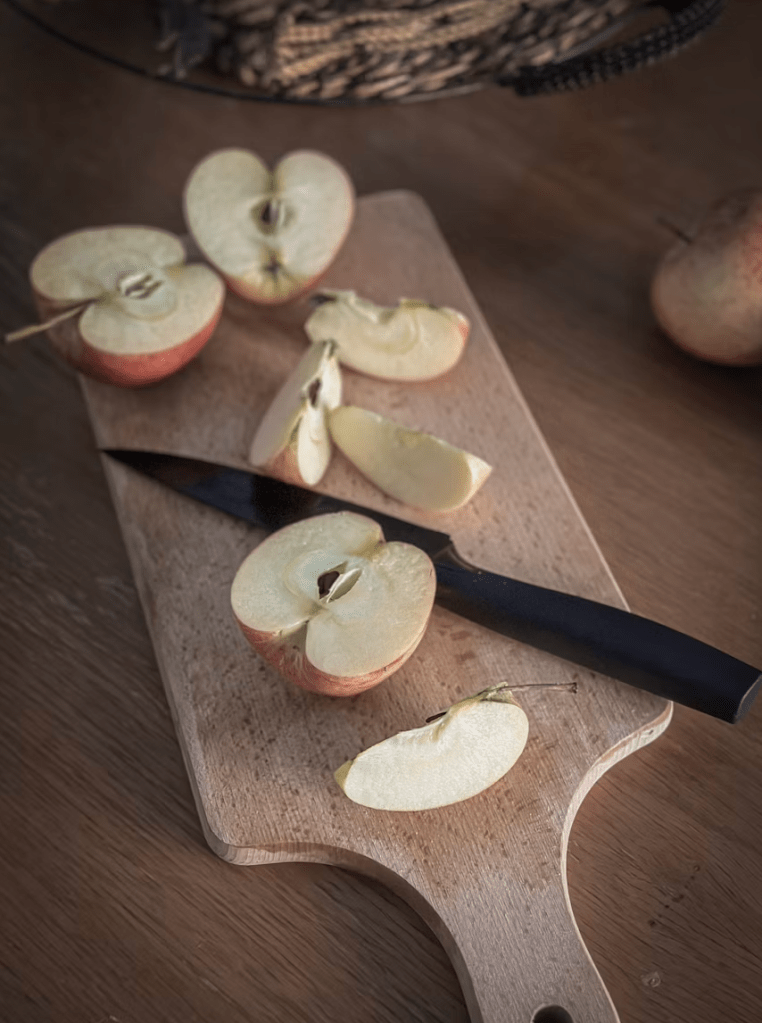
The experience ends with Steven standing in his kitchen with a knife, cutting open a piece of fruit with which to break his fast. His deep, shuddering breathing indicates to him he is either verging on or descending from a panic attack, and a strong impulse whispers to him to angle his knife toward himself, to quell the life all but him seem to have classified a farce. He sets the knife down and, instead, determines that if he is still feeling this way in an hour, he will call the long-distance friend who sent him the journaling prompts, asking for help. Or perhaps he will even call his brother?
For now and as he catches his breathing, Steven steadies himself with a single, implausible mantra: “It was only a dream.”

