At face value, Richard Matheson’s What Dreams May Come embeds a romantic tale of soul mates at first rent apart, then rejoined. This occurs because one of the souls, Chris, is killed in a car accident and enters the afterlife—a fact which for the principal third of the novel he refuses to believe. Then, Chris’s wife, Ann, kills herself in mourning, and Chris learns with horror that Ann has been relegated to a shadow realm which is the novel’s stand-in for hell. In the novel’s rousing conclusion, Chris must journey into this shadow realm in order to rescue and thus reunite with Ann.
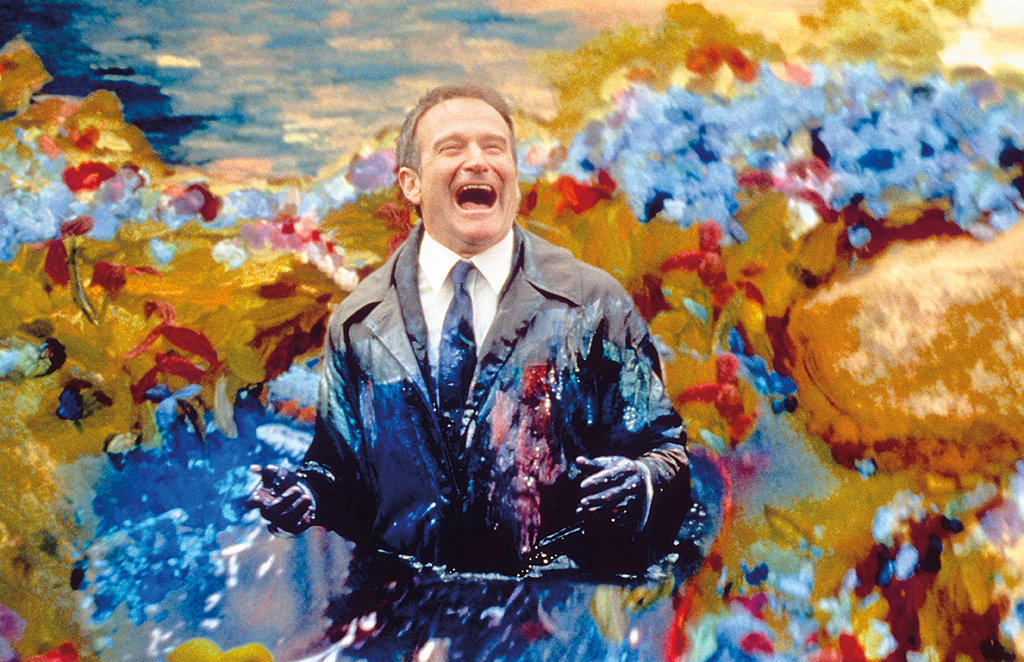
At times, the saga of Chris’s devotion to Ann reads as cheesy, since the former can think of virtually nothing else. In his own version of the afterlife, Chris has encountered a realm where communication is telepathic, travel verges on teleportation, and crime and suffering are relegated to memory, and yet Chris seems entirely unable to appreciate these innovations; in the end of the novel, he even goes so far as to be reincarnated for Ann’s sake, engineering a life in which he will meet and again marry her on earth.
And yet despite these contrivances, it is the mechanics of Matheson’s world which give the novel enduring interest. Most notably, Matheson envisions both heaven and hell as corresponding with “frequency,” meaning that the higher—and lighter—a person’s mental state upon their death, the more idyllic and empowering their iteration of the afterlife; as well as the converse, to the point that certain subjects remain unaware they are dead. This is the case for Ann, whose home becomes drab, dysfunctional, and a shrine of solitude; at the same time, Ann is left ignorant of the reason for these conditions, rendering her entire situation a metaphor for blindness and frustration.
Thus, Chris’s conundrum becomes to inhabit and convince Ann that she has died within her world, all without succumbing to that world himself. This is because according to Matheson’s dynamics, lowering one’s vibration means taking on a density of form, and in the extreme this density affects the mind as well as the physical body; that is, the subject forgets that they have willfully de-elevated their spiritual plane. Hence, Chris runs a great risk by descending to the level of his wife in her personal hell: if he does so at too great a length, Chris could forget that this location is voluntary for him, and he might become trapped there with Ann.

In the end, this is a choice Chris valiantly makes: unable to convince Ann that she has died and he is her husband, Chris acquiesces to merely subsist at the lower vibration with her, and the net result is that Ann for the first time recognizes him and the warmth of his love washes over her. Shortly thereafter, Chris reawakens in the heaven realm, told that his sacrifice was sufficient to raise him from the depths; unfortunately, he is also told that Ann remained unready to join him in a realm of greater freedom, and as such that she has been reincarnated on earth. This is where the novel reaches its conclusion, with Chris endeavoring to reincarnate himself in order that he and Ann may once again be rejoined.
While Chris’s single-mindedness about Ann can render him less identifiable as a character, and at times annoying, it is his decision to lower himself to Ann’s level, effectively eradicating his heightened consciousness, that stands as a profound metaphor of love. In demonstrating this sacrifice, Chris simultaneously relinquishes any ego he might lord over Ann, any sense that his perspective is more enlightened than hers; paradoxically, this humility in itself seems to free Ann, allowing her to “see” Chris and thus to recognize the falsity of her prison. Had Chris persisted in attempting to disabuse Ann of her worldview, perhaps he would have become increasingly saddled with frustration, thus losing his usefulness to them both and becoming more weighty, less conscious.
Matheson’s novel teaches us that in order to fully love someone, and thus liberate them, sometimes we need to sacrifice the very thing which we believe protects us from their misery, thereby joining them in a perspective which may feel noxious to us. If we do so, we illuminate that perspective through the bravery of our compassion, and one becomes two in a searing light that eradicates darkness.
 Jackson Holzberg Buckley
I love this blog because it reminds me of this wonderful, spellbinding film that moved me spiritually and emotionally and was visually stunning to watch and feel. I also love your summary of the emotional journey that Chris takes along the way…
LikeLike
Great review/critique of book vs. Film! 💕
Sent from my iPhone
>
LikeLiked by 1 person