Note: this post contains significant spoilers for not only the Matrix (1999), but also the Matrix Reloaded (2003) and Revolutions (2003). If you somehow haven’t seen these movies, go watch them! Then read this post.
:no_upscale()/cdn.vox-cdn.com/uploads/chorus_asset/file/23067292/the_matrix_48.jpg)
During the second act of the original Matrix film, the Oracle gives Neo a pair of contradictory, defeating prophecies: 1) contrary to Morpheus’s steadfast faith, Neo is in fact not “the One”—in other words, humanity’s salvation does not lie in Neo, and the latter will not obtain extraordinary powers, and 2) at some point very soon, Neo will have to make a “choice:” he will be able to preserve either his own life or Morpheus’s, but not both.
Shortly thereafter, Morpheus is captured and retained by agents, and secondary characters Tank and Trinity consider pulling Morpheus’s plug, thereby killing him. Recognizing that the second of the Oracle’s prophecies is coming true, Neo at the same time refuses to believe it—as he tells Trinity, for some reason he feels assured he can “bring [Morpheus] back,” a reconciliation specifically outlawed by the Oracle’s foreseeing of events.
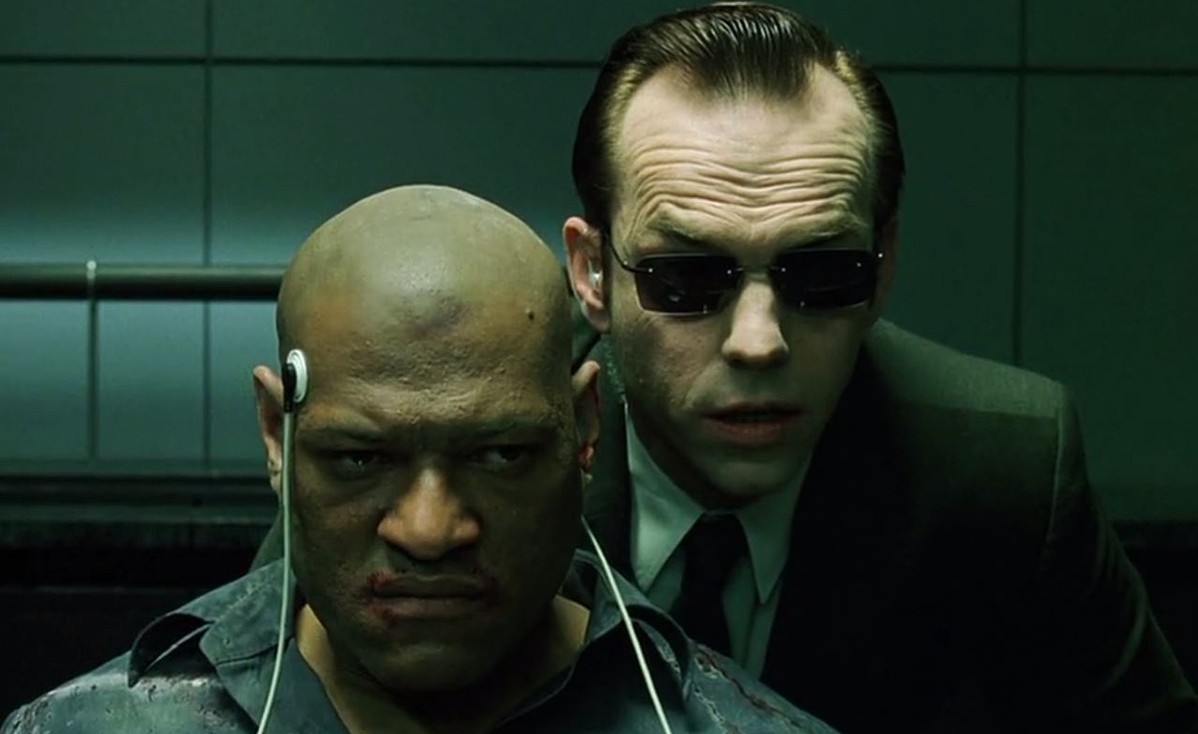
It is never explicitly stated in the film, but I have always interpreted Neo’s tossing aside the Oracle’s second prediction as stemming from his earnest belief in the first one: he is not “the One,” and hence views his own life as no more important than Morpheus’s. This being the case, Neo does not accept that Morpheus should be sacrificed for Neo, and this opens up Neo to perform his own daring acts of sacrifice seen in the film’s final act. Manifesting a paradox, Neo’s selflessness catalyzes his ability as the One, qualifying the Oracle’s entire transmission as pragmatic, if not directly true. As Morpheus clarifies to Neo after the latter has saved the former, the Oracle told Neo “exactly what [he] needed to hear”—by ridding Neo of his self-consciousness, she freed him to behave authentically and therefore discover his powers.
Despite the failings of the Matrix sequels, these films abound in deepening the first film’s dynamics of paradox, refusal, and resolution. Notably, this occurs in The Matrix Reloaded, during which Neo’s second meeting with the Oracle produces another stark prophecy: at some point Neo will be confronted with the prospect of Trinity’s death, and because Neo himself has received this vision, he will be unable to avert it; as the Oracle opines, any vision given to the One is incontrovertibly true.

Like the Oracle’s prophesying of Neo’s and Morpheus’s trade in the first film, this second pronouncement is complicated by another revelation, this time through the vessel of a figure newly introduced in The Matrix Reloaded, the Architect. As the Architect tells Neo, although Neo is indeed the One, the One is a “systemic anomaly” the machines not only anticipate, but exploit; while allowing the One to exist, they simultaneously allow a select group of humans to “escape” the Matrix and build Zion, which the machines then periodically destroy. As an element of this house-cleaning-process, the machines also routinely present the One with a choice: the One can either reboot the Matrix and allow a core group to survive the machines’ attack on Zion, or the One can refuse this offering and permit everyone in Zion—hence all earth’s “freed” humans—to perish.
As in the first film, Neo declines to make the prescribed choice, here because unlike the previous “systemic anomalies,” in this incarnation Neo has been equipped with a more rarefied form of love: that of his love for Trinity, one person for whom he is willing to sacrifice the rest of humanity. Although the machines fully expect Neo to make the choice all previous “Ones” have made, which is to reboot the Matrix and thus save Zion, Neo instead endeavors to save Trinity, thereby dooming Zion according to the terms of the machines’ deal. However, again as in the first film, Neo is ultimately able to transcend this binary and to save both Trinity—at least within the context of Matrix Reloaded—and Zion; this time, this unification is possible because of the existence of a computer virus, Agent Smith, regarding whom the machines make Neo a further deal.

As the One, the core of Neo’s ability rests not in fancy superpowers such as flying or stopping bullets, but rather in a disposition he professes to Morpheus in the very first film: when asked whether he believes in fate, Neo responds, “No—I don’t like the idea that I’m not in control of my life.” From this point forward through the Matrix trilogy, Neo is continually presented with apparently irreconcilable values, but due to his nature to sidestep these equations, he persistently finds a “third way” that resolves each paradox. A separate question is whether, through presenting the paradoxes to Neo in the first place, characters like the Oracle and Architect merely manipulate his inborn constitution as one who will seek this third way, but that reservation in itself can be addressed by something the Oracle tells Neo during their conversation in Reloaded: Neo is not “here” to “make [a] choice,” but rather to “understand” the choice he’s already made. In other words, the important variable to the path of the One is not altering reality, but deciphering himself.
Distilled to their essence and cleared of both gobbledygook and gratuitous action scenes, the Matrix films are powerful meditations on the illusion of choice within the context of not only prophecy, but a prescriptive reality more generally. That is, at base these films strive to ask the following question: if reality itself induces certain events through causality, which includes our very character, then is any choice possible? If so, what kind of choice would that be?
Side-stepping their own inquiry in meta-fashion, the films offer the following resolution: the important element in life is not making a choice, which may or may not be impossible, but rather learning about ourselves through the investigation of the choices we make. Through this self-understanding, we gain a chance of more holistically comprehending the universe into which we have been born, one whose rules have constructed everything including our very self; perhaps through this cyclical, interwoven path of understanding, a new universe can be born; that is because, with a replete understanding, we would finally access the opportunity of making an original choice.
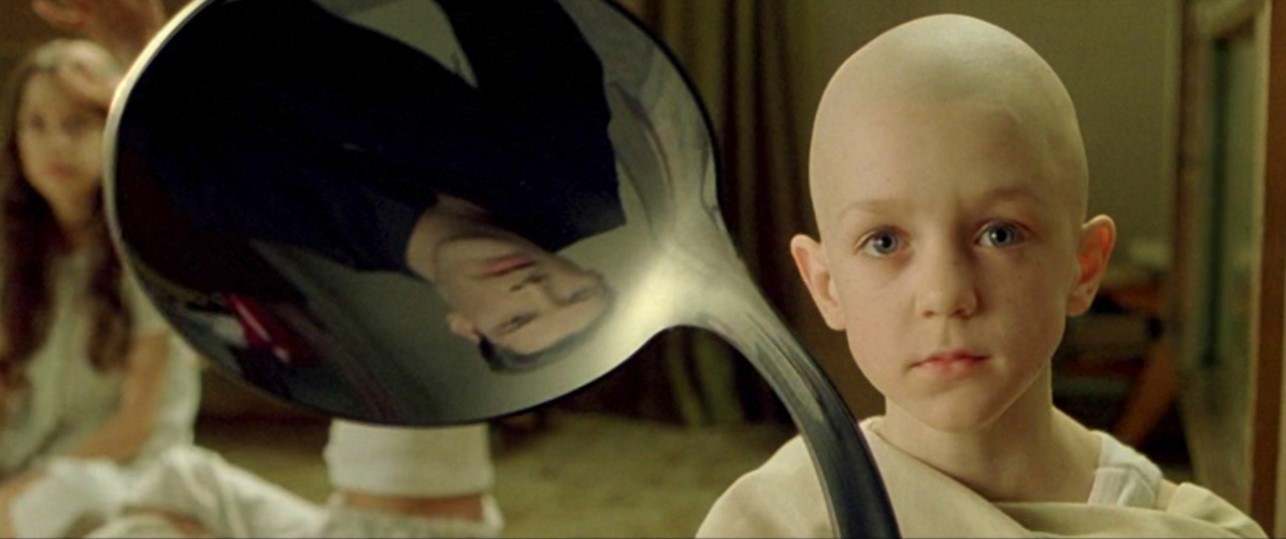
Paradoxically, the Matrix films explore the synecdochic quality by which self-understanding breeds universal understanding and vice versa, and potentially both factors can break apart and thus reform reality itself. As the bald boy coaxes Neo in the first film, “There is no spoon—it is only yourself!”
 Jackson Holzberg Buckley